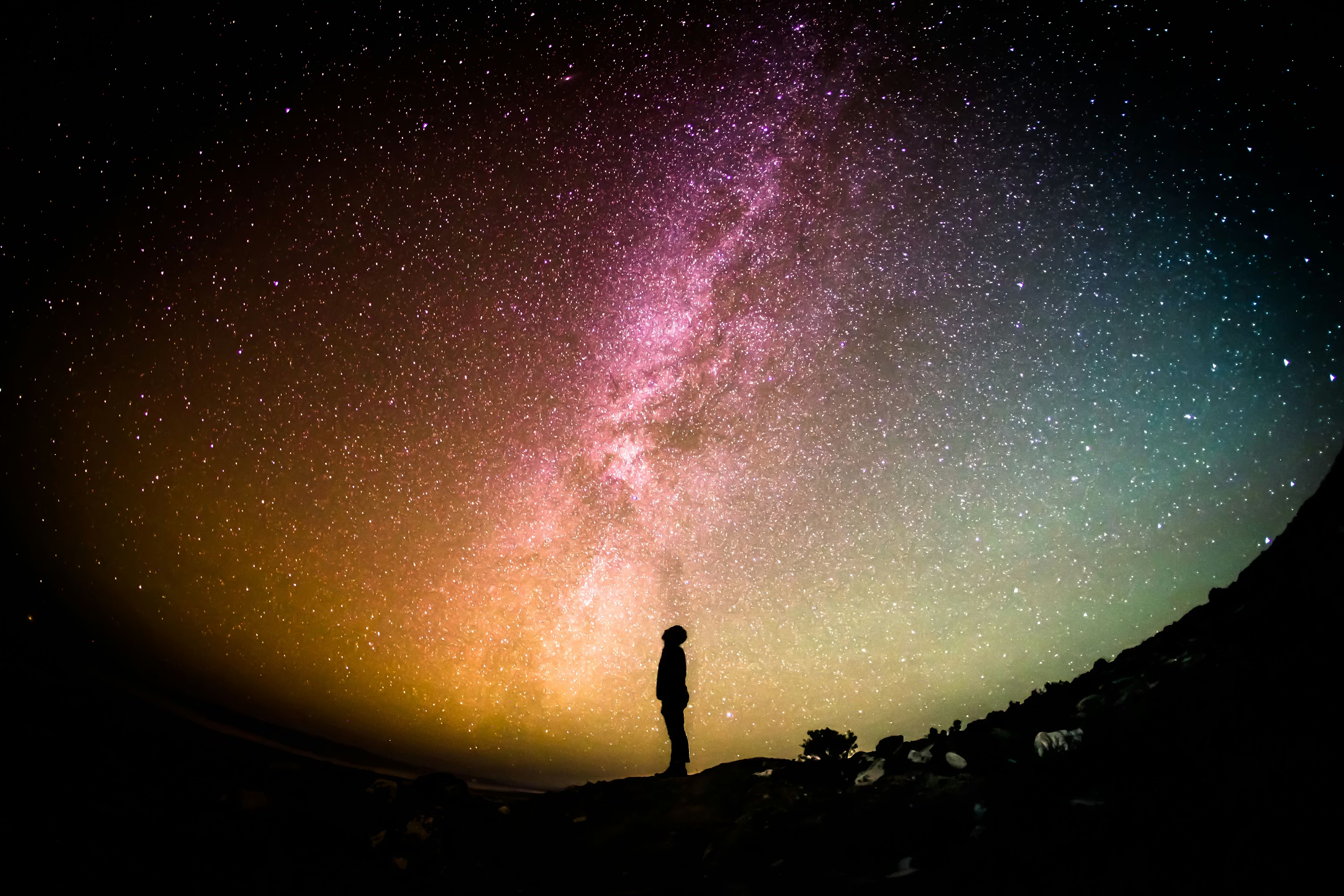
There is a question so immense it resists easy framing: how far does the universe go? Not how far we have looked, not how far our telescopes reach — but the universe itself. Does it end? Does it curve back on itself? Is it genuinely, incomprehensibly infinite?
The answer, frustratingly and fascinatingly, is that we do not know. But the reasons we do not know are themselves a window into some of the deepest physics ever discovered — and into the strange fact that the universe has drawn a veil around itself, a boundary we can never, even in principle, cross.
The Observable Universe
Begin with what we can see. Light travels at a finite speed — approximately 299,792 kilometres per second. The universe, as best we can determine, is about 13.8 billion years old. That means light has had 13.8 billion years to travel toward us. Naively, you might expect the observable universe to extend about 13.8 billion light-years in every direction.
But here is where it gets strange. The universe has been expanding the entire time light has been travelling. Space itself has been stretching. A photon emitted from a galaxy 13.8 billion years ago has been riding a universe that has been growing beneath it, carrying it further along. When we account for this expansion, the observable universe turns out to extend approximately 46 billion light-years in every direction — a sphere some 93 billion light-years across.
We can see light that originated 46 billion light-years away, even though the universe is only 13.8 billion years old. The space between us and the source has stretched in the interim.
This is our cosmic horizon — not a wall, not an edge, but a limit of visibility. Beyond it, the universe almost certainly continues. But light from those distant regions has not had time to reach us, and — given the accelerating expansion of space — it never will.
The Expansion Is Accelerating
In 1998, two independent teams of astronomers studying distant supernovae made a discovery that upended cosmology. The universe is not merely expanding — it is expanding at an accelerating rate. The cause is attributed to something we call dark energy, a mysterious component that makes up approximately 68% of the total energy content of the universe, yet whose nature remains almost entirely unknown.
The consequence for our cosmic horizon is profound. As expansion accelerates, galaxies beyond a certain distance are being carried away from us faster than light can cross the growing gap. They have already crossed a threshold called the Hubble horizon — the distance at which recession speed equals the speed of light. Light emitted by those galaxies today will never reach us. They are gone from our observable future.
More unsettling still: over cosmic timescales, even some galaxies we can currently see will eventually be swept beyond our reach. The night sky of the far future will be emptier — not because the stars have died, but because the universe will have carried them away, out of sight and out of contact forever.
What Relativity Says About Limits
Special relativity places its own hard limit on what any observer can know. Nothing carrying information — no particle, no signal, no influence of any kind — can travel faster than light in a vacuum. This is not merely a technological barrier. It is a structural feature of spacetime.
The consequence is a concept called causal structure. Every event in spacetime has a region of influence — a "light cone" — within which it can send signals, and from which it can receive them. Events outside the light cone are, by construction, causally disconnected. They cannot affect you; you cannot affect them. The universe arranges itself into regions of mutual influence separated by unbridgeable causal horizons.
General relativity adds further complications. Around black holes, for instance, there is an event horizon — a surface from within which no signal can escape to the outside universe. An observer falling into a black hole crosses this horizon without feeling anything dramatic at the moment of crossing, but can never communicate with the world they left behind. The causal disconnection is absolute and permanent.
The Edge of Knowledge
Perhaps the deepest limit is not spatial at all. Even if we could somehow survey the entire observable universe perfectly, we would still be sampling a single point in a vastly larger cosmic landscape — if the inflationary picture of the early universe is correct.
Cosmic inflation — the theory that the universe underwent a period of exponential expansion a tiny fraction of a second after the Big Bang — predicts that the universe is enormously larger than the observable patch we inhabit. Some versions of the theory suggest the universe is effectively infinite. Others allow for a multiverse of causally disconnected regions, each potentially with different physical constants, different laws.
We are, in the most literal sense, prisoners of our own light cone — able to see and know only that which has had time to reach us across the history of the cosmos.
Whether those other regions exist, and what they contain, we will never be able to determine by observation. They are, by definition, beyond every horizon we have discussed. They are not merely unknown — they are, in principle, unknowable.
Living at the Edge
There is something both humbling and exhilarating about these limits. Humbling, because they remind us how small our window onto the cosmos truly is. We inhabit one pale point in a universe that stretches — in all likelihood — far beyond anything our instruments will ever reach.
But also exhilarating, because we have arrived at these conclusions through mathematics, through the logic of physical law, through careful observation of the light that has managed to reach us. We know the horizons exist. We know approximately where they lie. We can reason about what lies beyond them even when we cannot see it.
That is perhaps the most remarkable thing of all: that creatures on a small rocky planet circling an ordinary star, in the outer regions of an unremarkable galaxy, have managed to map the boundaries of their own cosmic prison — and to understand why those boundaries are there.