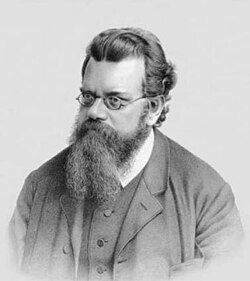
There is a grave in Vienna's Central Cemetery, and carved into its headstone is one of the most profound equations in the history of science. It was placed there not by an institution, not by a government, but by a physicist who understood what its author had given the world — and what the world had taken from him in return.
The equation is S = k log W. The man is Ludwig Boltzmann. And the story of how that equation was born is a story about genius, isolation, and the peculiar cruelty that physics sometimes visits upon its greatest minds.
A World Before Atoms
To understand what Boltzmann did, you must first understand the world he was working in. In the second half of the nineteenth century, the existence of atoms was not an established fact — it was a hypothesis. A contested, disputed, philosophically murky hypothesis. The dominant school of thought in physics, led by formidable figures like Ernst Mach and Wilhelm Ostwald, held that physics should deal only with measurable, observable quantities. Atoms, being too small to see, were therefore suspect — perhaps merely a useful fiction, not a physical reality.
Into this world stepped Ludwig Boltzmann — large in frame, large in personality, prone to tremendous swings of mood, and absolutely certain that atoms were real.
Born in Vienna in 1844, Boltzmann displayed an extraordinary mathematical gift from an early age. He studied under Josef Stefan, whose name now graces the Stefan-Boltzmann law of thermal radiation, and quickly distinguished himself with a mind that could hold vast, intricate physical systems in his imagination and subject them to rigorous mathematical analysis.
The Statistical Revolution
The central problem Boltzmann attacked was the second law of thermodynamics: the law of entropy. First stated rigorously by Rudolf Clausius, the second law declares that in any isolated system, entropy — a measure of disorder — can only increase or stay the same. It never spontaneously decreases. Heat flows from hot to cold, not cold to hot. Organised structures decay into disorder. The arrow of time points, always, toward greater entropy.
But why? What is the physical mechanism behind this seemingly absolute law?
Boltzmann's answer was breathtaking in its simplicity and devastating in its implications. He proposed that entropy was not a fundamental quantity — it was a statistical one. If you take a gas made up of an enormous number of atoms or molecules, each moving in random directions with varying speeds, then macroscopic properties like temperature and pressure emerge from the collective statistical behaviour of these particles. And entropy, Boltzmann showed, is proportional to the number of microscopic configurations that correspond to a given macroscopic state.
In other words: disordered states are overwhelmingly more probable than ordered ones, simply because there are vastly more ways to be disordered. A gas fills a room because the number of configurations in which it is spread throughout the room is astronomically larger than the number of configurations in which it is confined to one corner. The second law is not absolute in a fundamental sense — it is a statement about probability so overwhelming that violations, while theoretically possible, are so vanishingly rare they are for all practical purposes impossible.
The second law of thermodynamics is not a law of necessity — it is a law of overwhelming probability. Order decays not because the universe forbids order, but because disorder outnumbers it by incomprehensible magnitudes.
The Battles
You might expect this insight to have been celebrated. It was not. The backlash was fierce, sustained, and deeply personal. Mach and Ostwald led the charge, insisting that Boltzmann had smuggled unobservable entities — atoms — into physics under the guise of mathematics. His statistical mechanics, they argued, built a grand edifice on a foundation that might not exist.
The debates at scientific conferences were brutal. Boltzmann was a gifted polemicist and threw himself into the arguments with characteristic intensity — but he was also emotionally fragile in ways that his public persona concealed. He suffered from severe depression, what we would today recognise as bipolar disorder. The attacks on his life's work were not merely intellectual assaults; they struck at something he could not separate from his sense of self.
He wrote in 1898: "I am conscious of being only an individual struggling weakly against the stream of time." There is something heartbreaking about the sentence, coming from a man who had done as much as anyone alive to understand the nature of that stream.
Vindication Too Late
The final vindication came, but too slowly. In 1905, Albert Einstein — the same year he published special relativity — wrote a paper on Brownian motion, the random jiggling of small particles suspended in a liquid. Einstein showed that this motion was precisely what you would expect if the liquid were made of atoms colliding with the particles. It was direct, quantitative, observable evidence for the atomic hypothesis.
Three years later, Jean Baptiste Perrin performed the experiments that confirmed Einstein's predictions to extraordinary precision. The atom was real. Boltzmann's statistical mechanics was vindicated. Mach and Ostwald were wrong.
But Boltzmann did not live to see it. In September 1906, while on holiday in Duino near Trieste with his wife and daughter, he took his own life. He was sixty-two years old. The confirmation of his life's work was less than two years away.
What He Left Behind
The equation on Boltzmann's headstone — S = k log W — is one of the most important in all of physics. The constant k, named the Boltzmann constant in his honour, appears throughout thermodynamics and statistical mechanics, linking the microscopic world of atoms to the macroscopic world of temperature and heat.
But his legacy extends further than any single equation. Boltzmann pioneered the statistical approach to physics — the idea that the behaviour of complex systems emerges from the probabilistic behaviour of their constituent parts. This framework underpins not only thermodynamics but the foundations of quantum mechanics, information theory, and the modern understanding of complexity and chaos.
The concept of entropy itself — his entropy, the statistical entropy — has migrated far beyond physics. Claude Shannon borrowed it for information theory. It appears in biology, in economics, in the study of neural networks and machine learning. Boltzmann's insight that disorder has a mathematical structure, that randomness can be quantified and reasoned about, was one of the foundational intellectual moves of the modern age.
He did not merely explain why things fall apart. He gave us the mathematics of falling apart — and in doing so, illuminated the deepest asymmetry in nature: the arrow of time itself.
The universe tends toward disorder. We know this not because some cosmic law demands it, but because disorder is simply far more probable than order — and probability, given enough time and enough particles, becomes indistinguishable from necessity. That is Boltzmann's gift: not just an equation, but a way of seeing.